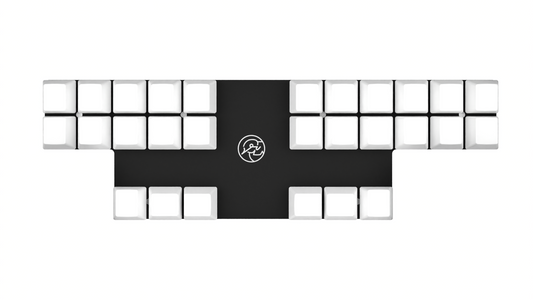
Since 2021, I have been using stenography exclusively as my primary method of input on a computer. I will sometimes use Colemak when I don't have a stenography keyboard handy, but most of the work I do on the computer, either at work or at home, is done with stenography. I mainly use the Polyglot, but I sometimes whip out the Asterisk with Electric Foam for that zero-gram actuation. The Uni has served me well when I first started learning stenography, but I find no need to switch to it when I already have the Polyglot. So how did I get to this point and what are some advantages or disadvantages of using stenography full-time?
I started learning stenography in August of 2020. I first came across the Open Steno Project website and was instantly hooked by the concept. I felt that stenography was an ingenious method of typing. Pressing multiple keys at once! Why didn't I think of that! I was extremely impressed by the 10 Fast Fingers typing test demonstration by Mirabai Knight and I felt I just had to learn stenography. The way Mirabai masterfully pressed multiple keys at once on a curious ortholinear keyboard was so satisfying and captivating. I dug deep and found out you could start learning stenography using a regular qwerty keyboard, so I downloaded Plover and started practicing. I read through "Learn Plover!", the free online textbook that teaches the basic concepts of stenography. I started practicing on QwertySteno, which was an interactive learning website that allowed you to learn stenography without even having to download Plover. I bought myself what I thought was an NKRO mechanical keyboard, but was actually a membrane 6-kro keyboard, which I returned and replaced with an actual NKRO mechanical keyboard. And so my steno journey began.
When I was first learning stenography, I focused on building speed on common words by drilling typing tests on StenoJig and MonkeyType and I slowly built vocabulary through trial and error. Even though I knew how stenography worked and I had learned what keys correspond to which sounds and letters, I still didn't know how to write all the words I needed to write. This is because stenography is not an exact science like a qwerty keyboard. Anyone can use a qwerty keyboard by simply pressing the letters to spell out the word they want to write. That's not how it works with stenography. In stenography, you sound out the words, but there are many ways to sound out words. For example, the word "common". There is only one way in qwerty to type this word— by pressing all the letters sequentially. However, in stenography, this word can be stroked as KOPL/PHOPB (kom-mon) or as KPHOPB (kmon). Now multiply this for pretty much all words in the English language. Figuring out which strokes corresponds to which words took a lot of time, effort, trial, and error. Depending on the steno theory you choose, this learning process can be easier or harder. I started with Plover Theory which may have made it more difficult compared to something like Lapwing Theory.
But I still persisted. I still wanted to steno like Mirabai Knight and Stanley Sakai. Slowly, over the years, I practiced steno on and off. After about a year, I was consistently writing over 100 wpm with stenography. And around 2022, I was finally ready to try going full-time with using stenography on my computer.
When I first switched over to stenography cold-turkey, writing anything on the computer felt like walking on stilts. I had to think hard about how I was going to type the next word. I felt like my vocabulary had shrunk. I could consciously feel that I was subconsciously choosing not to use "difficult" words when writing. "Difficult" meaning words that I didn't know how to write with stenography. I was constantly fingerspelling words that I couldn't stroke it by my third or fourth attempt. It felt like I would eventually become an ineloquent person if I continued using stenography because it was actively restricting the ability to express myself. I think I remember switching back and forth between steno and regular typing a few times during this time. I remember I would give up and try again later several times.
But eventually, things actually got better as my vocabulary improved. I had the Plover "Suggestions" window always open so whenever I fingerspelled words, I can easily see what strokes I should have used. After a few months, I started to feel more comfortable using stenography for all my daily tasks. Writing essays for school, writing emails, searching the internet, chatting on discord; I did everything with stenography. I estimate it took me several months from when I decided to go full-time with stenography to actually feel competent using stenography for all my daily computer tasks.
One advantage to going stenography full-time is that everything becomes practice. Regular ordinary computer usage helps me improve my stenography skills automatically. The disadvantage is that at the beginning it feels slower than regular typing and you need to spend extra brain power thinking of how to type the word in stenography. This may slow down your ability to actually think of the words you want to write.
One disadvantage is that it is very slow at the beginning. Yes, there will be many words that can be written much faster with stenography, but whenever you hit a word you don't know how to stroke, the time you saved is basically canceled out. But over time as you build more vocabulary and speed, the words you don't know how to stroke will grow less and less and your intuition for stroking new words will get more advanced. Eventually, using stenography will be much, much faster than regular typing. I use Colemak at about 100 words per minute, but after about a 1.5 to 2 years of practicing stenography, I was much faster at using stenography than Colemak.
Another major advantage of using stenography full-time is the ergonomics. Stenography is much more ergonomic than regular typing. Even compared to Colemak or Dvorak, stenography is much more ergonomic for the hands and fingers. You barely have to move your fingers when you use stenography because all the keys you need are directly under your fingers.
Even with alternative keyboard layouts that move common letters to the home row position still require you to reach for the uncommon letters because of the inherent layout of the standard keyboard. There are 26 letters in the English alphabet that each need a key on a standard keyboard, which means each finger is responsible for reaching approximately 3 keys. The typical steno layout only has 23 unique keys, which means each finger can be responsible for only about 2 keys each. This makes a huge difference when typing long term.
Additionally, the amount of movement necessary to write a single word is drastically different between stenography and regular typing. A word like "between" can be stroked in one movement in stenography by pressing TWAOEPB in one motion, whereas on a regular keyboard, you need to press down each letter b-e-t-w-e-e-n in the correct order which is the equivalent of seven movements.
This entire blog post was written with stenography, on a Polyglot prototype with 20 gram springs, using Plover. No regular typing was used. The time of writing this is 2026, approximately 6 years after I first started learning about stenography. I prefer using stenography much more than regular typing. I can write words faster and have more time to think about the words I want to type when I use stenography.
I spend less energy and effort on the act of expressing the words I want to write. Writing is a less self-destructive task when I use stenography. I notice that if I have to write for more than an hour with regular typing, my hands start to hurt. Oftentimes, my hands, fingers, and wrists will feel sore the day after using regular typing. With stenography, I can write for hours and hours with no fatigue. Stenography is just more enjoyable.